Proprietary software
Proprietary software, adapted to each business
We do not market closed applications or generic user licences. We start from our own software — a project management and invoicing ERP, time tracking and presence management, and AccouRate® for financial analysis — and build an application for each client, aligned to their operations, their structure and the systems they already use.
How we approach the product
Every implementation is a development in its own right. We start from a built and proven base and adapt it to each business’s processes, terminology and organisational structure.
We modify the application to cover the client’s actual operations: new fields, statuses, approval flows, categories, calculations and dashboards specific to their activity.
An application that unifies the full project cycle — client origin, delivery, invoicing and collection — connected to the accounting system and configured to each organisation’s activity.
An HR module for working-time recording, management of the hybrid model, desk allocation and absences, with a real-time presence board.
Software for advanced financial analysis, predictive modelling and sector benchmarking, with solvency and risk assessment and the incorporation of ESG criteria.
We connect the application to the client’s systems — accounting, banking, payroll, CRM or sector-specific tools — through integration with any provider that exposes technical access.
Project management and invoicing ERP
A management application that centralises the full life cycle of a project: from the client’s origin through to invoicing and collection, connected to the accounting system. It replaces a set of scattered spreadsheets with a single source of truth linking what has been worked, what has been invoiced and what has been collected. It applies to any sector: business areas, project categories, board statuses, invoicing rules and dashboards are modules we configure and develop according to each client’s operations.
Clients and organisational structure
Client records including the relationship between entities belonging to the same group, so that each project is assigned to the entity it corresponds to and invoicing follows the rules the organisation defines. The origin of each client is recorded as well, so that where business comes from can be analysed.
Projects and tracking boards
Projects are structured according to the categories and organisational units each business uses. Every team has its own board, with the statuses that reflect its way of working, together with deadlines, recurrence, tasks and comments. Categories and statuses are defined at implementation and changed whenever the process changes.
Invoicing connected to the accounts
Tracking of the invoice life cycle, from forecast through to collection, with everything still to be invoiced planned without affecting the accounting records. Line items, surcharges and issuing rules are all configurable. Integration with the accounting system is two-way and adapts to whichever system the organisation uses, so that the accounts remain the reference record and no duplication or discrepancies arise.
Profitability and portfolio
Recording of hours by person and project, with rate and cost by profile, allowing the real cost and margin of each project to be calculated. Dashboards present the state of the portfolio, revenue against actual cost, and the invoicing forecast by month.

Time tracking and presence management
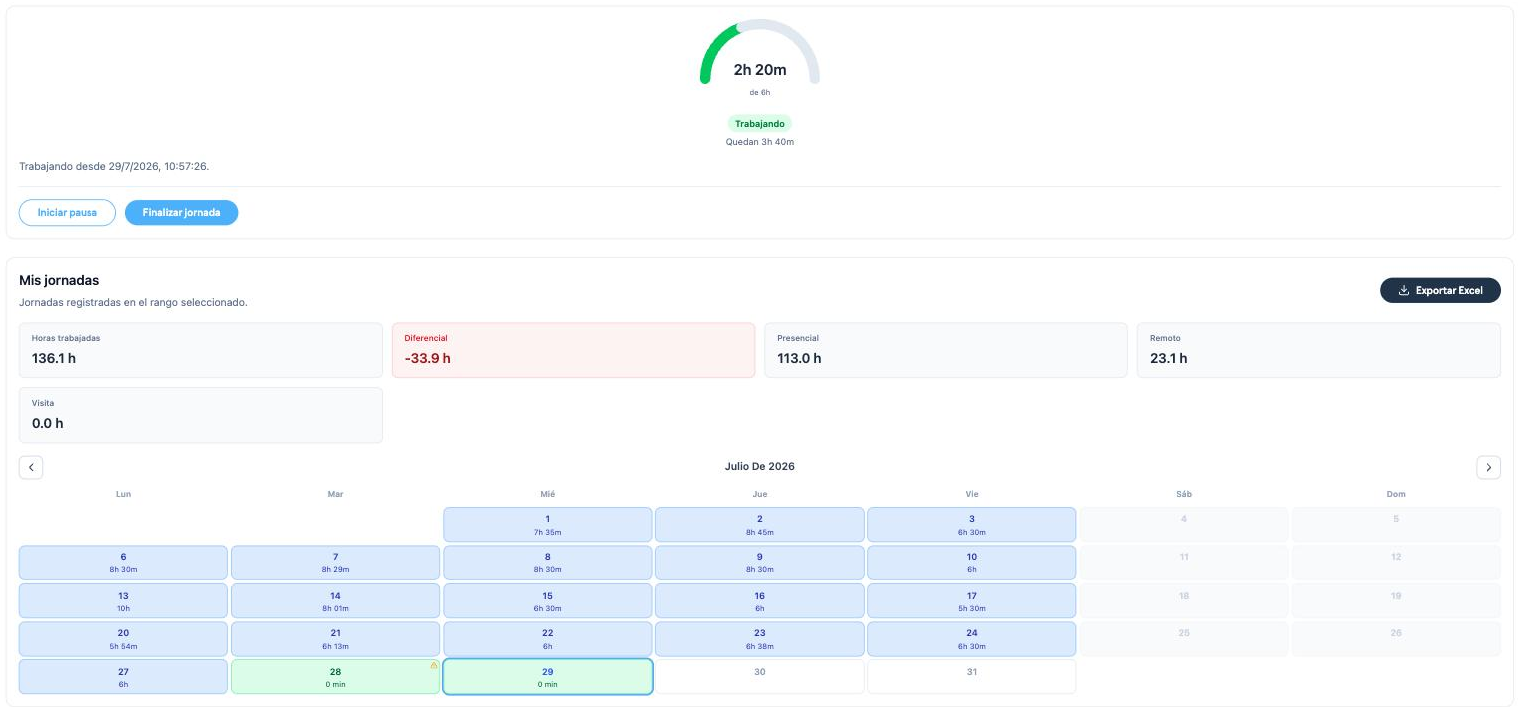
An HR module independent of the ERP, aimed at compliance with the statutory obligation to record working time and at the orderly management of the hybrid model. It covers daily clocking, telework, desk allocation and absences, consolidating all of that information into a presence board updated in real time.
Clocking with geolocation validation
Recording of clock-in, breaks and clock-out under whichever rules apply. Geolocation distinguishes on-site from remote work and flags entries that do not match what was planned, with hour summaries by period.
Telework and desk management
Telework requests and approvals, and management of the available desks and their allocation, including reallocation between people whenever the working model requires it.
Absences and holidays
Absence management with whichever types each organisation defines, a balance per employee and year, automatic calculation of working days, and a request and approval flow.
Real-time presence board
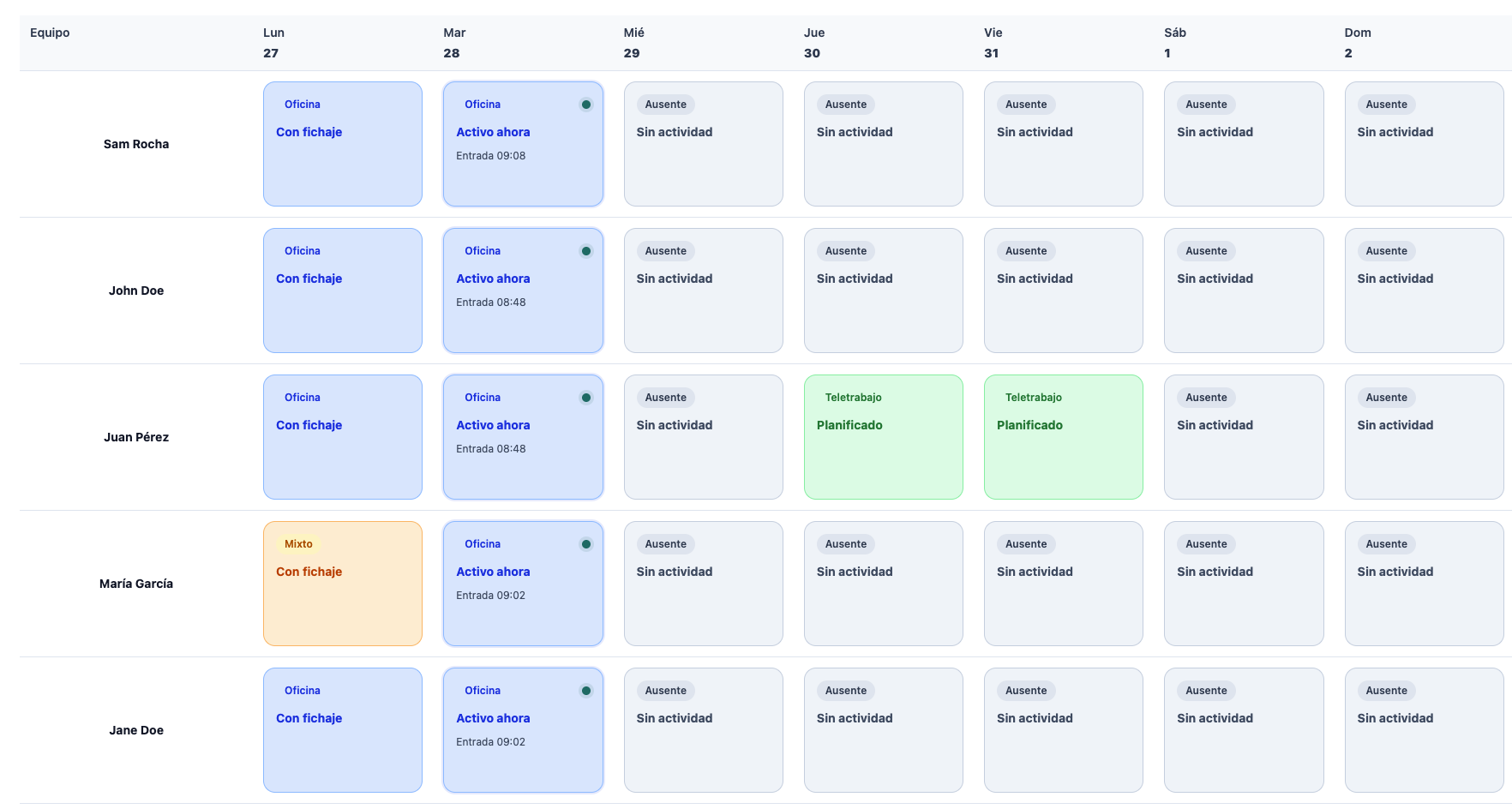
The team’s situation at any moment — who is on site, working remotely or absent and for what reason — with desk occupancy and an overall summary.
AccouRate®: financial analysis and benchmarking
AccouRate® is the software through which we automate advanced financial analysis, predictive modelling and sector comparison. It applies consistent criteria to every analysis and generates reports from the data loaded, with the ratios, peer groups and dashboards defined according to each organisation’s valuation criteria.
Advanced financial analysis
Assessment of companies and scenarios through key metrics, ratios and predictive modelling, giving a complete view that is comparable across periods.
Sector benchmarking
Comparison of results and positioning against companies of the same sector and size, to identify strengths and improvement areas from data.
Risk, solvency and ESG criteria
Analysis of solvency and associated risk, with environmental, social and governance metrics built into the report itself.
Automatic reporting
Automatic generation of reports and visualisations from the data loaded, on consistent criteria across every analysis.
Adaptation and implementation process
Every implementation starts from the application in operation and builds on it: we assess what it covers, agree the adaptations required, develop and integrate with the client’s systems, and support go-live and subsequent development.
Analysis of operations
We review procedures, organisational structure and the systems in use, and present the application in operation so that what it covers and what requires adaptation can be assessed against it.
Definition of the adaptations
We agree the functional modifications the application will incorporate: structure of areas and categories, board statuses, invoicing rules, calculations, permissions and dashboards.
Development, integrations and migration
We build the adaptations, establish the integrations with the client’s systems and migrate existing information from their current system or from the spreadsheets in use.
Go-live and ongoing development
We train users by profile, provide close support through the first weeks of operation and incorporate new functional requirements as the client’s activity evolves.
FAQs
Frequently asked questions about our software
Is it a closed product or is it adapted to our operations?
It is adapted. We do not market a standard application under a user licence: we build an application for each client from a base that is already built and proven, and modify it to cover their operations, their structure and their systems environment. New functional requirements are incorporated over the course of the relationship.
Which systems can it integrate with?
Any provider that exposes technical access: accounting, banking, payroll, CRM or sector-specific tools. The application is adapted to connect to whichever accounting service is in use, with two-way synchronisation of invoices issued and collected. Where a source system offers no integration, we resolve the connection through automation over its own interface.
Does it work for any sector?
Yes. The application is modular and modifiable: business areas, project categories, board statuses, invoicing rules, cost profiles and dashboards are all defined according to each client’s activity. It is not a standard product the organisation has to fit its way of working around: we adapt the application to existing operations and build whatever modules the sector requires.
Does the time tracking comply with Spanish working-time regulation?
Yes. It records the start, breaks and end of the working day, distinguishes on-site from remote work through geolocation, retains history for the required period and produces the reports required in a labour inspection. The configuration is aligned during implementation with the applicable collective agreement.
Can the modules be implemented separately?
Yes. The ERP, time tracking and AccouRate® are independent applications and are implemented separately according to requirements. Where they are used together, the integration between them prevents duplicate data entry.
How is the data managed?
It is hosted on infrastructure located within the European Union, GDPR compliant and supported by our information security management system certified to ISO/IEC 27001. Where the case requires it, the application is deployed on the client’s own infrastructure. The information is portable: it is delivered in a standard, usable format at any time, at the client’s request.
ALS Innovation
Tell us which area of management you need to cover and which systems you work with. We will show you the application in operation and the adaptations your case would require.